Meme Warfare – The Weaponisation of Internet Humour
Jemma Ward | May 25, 2026 | 12 MIN READ
This blog builds on our webinar from 14 May 2026, Meme Warfare: The Weaponisation of Internet Humour, available free in the OSINT Combine Academy library.
Once considered nothing more than niche internet humour, memes are now a strategic tool for communicating narratives and crafting information campaigns. In this blog, we’ll look at how memes – compressed narratives and jokes that (usually) riff off popular culture images – have been leveraged for a range of strategic purposes online. We’ll also investigate some of the challenges for OSINT practitioners who seek to understand this space, including attribution and measuring impact.
What Is a Meme?
The term “meme” was coined by Richard Dawkins in his 1976 book The Selfish Gene. He defined it as:
“A unit of cultural information that spreads and evolves through imitation, similar to the replication of genes in biological processes.”
When Dawkins wrote it, he wasn’t thinking of cats making poor spelling decisions. He meant the fundamental cultural building blocks – a song snippet, a piece of architecture, a shared in-joke – jumping from human brain to human brain.
The term adapted perfectly to the 1990s internet meme: simple images paired with text, hopping from person to person. The speed of spread was so fast that scientists began comparing meme transmission to viral contagion.
The Big Picture (from Little Pictures)
The impact of memes on modern communication – and on the dissemination of both accurate and inauthentic information – cannot be overstated. Today, we are drowning in AI-generated ‘slopaganda’: AI tools pushing out narratives on an industrial scale. These humorous pictures and videos do far more than entertain. They are powerful cultural tools that can shape public sentiment, influence election outcomes, deliver malware, and even help win wars.
Case Studies and Practical Approaches to Investigating Meme Warfare
In the next part of this blog, we will look at some case studies of ‘meme warfare’, along with challenges and approaches for OSINT practitioners seeking to understand the impact and forces behind a campaign.
Case Study One: Ukraine War and ‘NAFO’
Following Russia’s invasion of Ukraine in February 2022, pro-Ukraine sentiment grew rapidly across social media platforms, and morale-boosting propaganda was amplified by both official and non-official accounts. One example was the mysterious ‘Ghost of Kyiv’, an unnamed fighter pilot said to have shot down forty Russian planes. The Ghost of Kyiv, of course, didn’t exist, but that didn’t stop the memes from flying. On 25 February 2022, a user posted the meme below in the subreddit r/dankmemes (does what it says on the box!). It received nearly eight thousand upvotes.
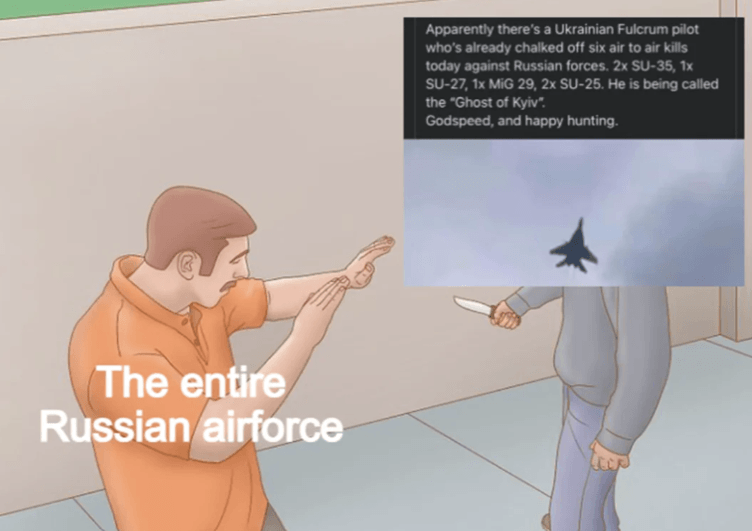
Of the top twenty posts on Reddit with the phrase ‘Ghost of Kyiv’ in the title (all with thousands of upvotes each), nine of them are memes (in either image or video format). Memes about current events aren’t, of course, anything new – but the combined reach, based purely on upvote counts, of ‘Ghost of Kyiv’ memes in February 2022 was more than thirty thousand (we’d expect views to be far higher). That’s a significant audience – and, more importantly, it’s an audience who may not routinely engage with geopolitical content.
Still, what does reach matter if people are just sharing humorous pictures? In the case of the Ghost of Kyiv memes, they all reflected a clear narrative of Ukrainian success – the message was that, despite Ukraine’s inferior military assets, it was winning the war.
Note on narratives: A narrative is a way of telling a story about a person, topic or event. Counter-messaging and counter-narratives that disrupt and debunk (and, ideally, prebunk) manipulative narratives acts as inoculation against inauthentic content.
In May 2022, a new wave of meme-based narratives about Ukraine and Russia swept across social media platforms. Pictures of Shiba Inus (remember Doge?) accompanied pro-Ukraine messaging. NAFO – the North Atlantic Fella Organisation – was formed. NAFO’s website has an entertaining section on the movement’s background, along with some pivotal moments and memes: https://nafo-ofan.org/pages/we-are-nafo
NAFO is a grassroots movement and an example of digital activism – although you’ll find plenty of accusations online of it being a CIA Psy Op (NAFO founder Kamil Dyszewksi’s X profile has a tongue in cheek nod to that. His location is listed as ‘Langley, Virginia’). Over the last four years, NAFO posters have both harnessed and invented a colourful variety of pejoratives, imagery and euphemisms to mock Russian supporters on social media platforms. You might spot hashtags like #vatnikcope, invocations of NAFO’s Article 5, or references to the 69th Sniffing Brigade – all posted by ‘fellas’. Kind of confusing, right?
This is a key challenge for OSINT practitioners investigating ‘meme warfare’. How do we gather up the various layers and threads of a narrative-based campaign, and, more importantly, how can we confirm we understand it? Grassroots online movements might initially seem impenetrable, layered with confusing terms, sarcastic memes, heavy irony, and ‘shitposting’ – I think this is the first instance of swearing in an OSINT Combine blog. We won’t make a habit of it!)
Well, a key approach is to circle back to narratives. Can we detect a clear narrative about an event or topic from social media posts and memes? Look at the meme below and take a moment to consider the narrative it is presenting and/or countering.
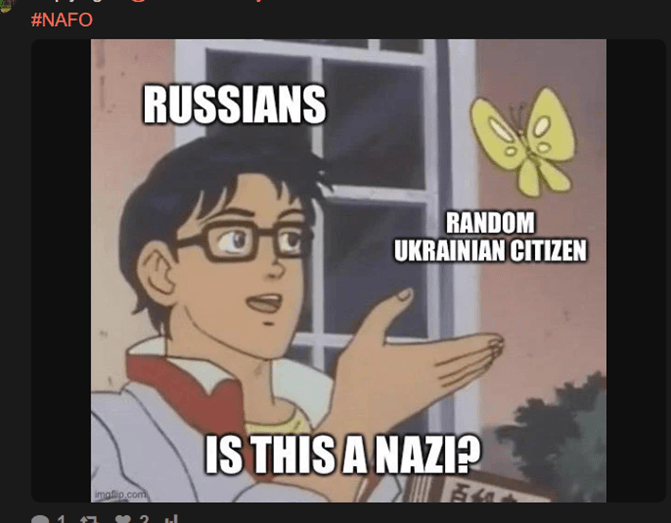
While it can be useful to research the memes themselves – where they originated from, how long they’ve been used, and where on social media they’ve been shared – we don’t necessarily need that context. In the meme above, you probably detected evidence of both a narrative and counter-narrative.
- Narrative: Ukrainians are Nazi sympathisers and/or support a Nazified regime.
- Counter-narrative: Pro-Russian narratives incorrectly and dishonestly label Ukrainians as Nazis.
NAFO memes have been used to counter Russian narratives about war in Ukraine, including (but not limited to):
- Ukraine as a Nazi regime
- Russian-speaking Ukrainians need ‘liberation’ by Russia
- Ukraine is a NATO (and/or CIA) puppet state
- Military and economic support for Ukraine is doomed/pointless
Challenges for OSINT Practitioners: Understanding the Messaging Campaign
To understand a messaging campaign – along with its impact, and whether it is a coordinated or grassroots campaign – we can use a combination of tools and tradecraft.
It’s useful to understand how old a messaging campaign is. Understanding the seeding and growth of a message over time lets us correlate it to major events, focus our searching (to a specific timeline), and see whether a campaign has exploded in reach or ‘gone viral’. Some of the tools that can assist include:
- Google Trends provides insight into searches containing key terms from a messaging campaign (i.e. searches for ‘NAFO’ over time).
- Open Measures, while somewhat limited in terms of date searching, is useful for identifying where a messaging campaign has developed on or transitioned to niche or fringe platforms, such as 4chan, Gab or Telegram.
- Google’s ‘Forum’ search filter can identify where a message is being discussed on forums and message boards.
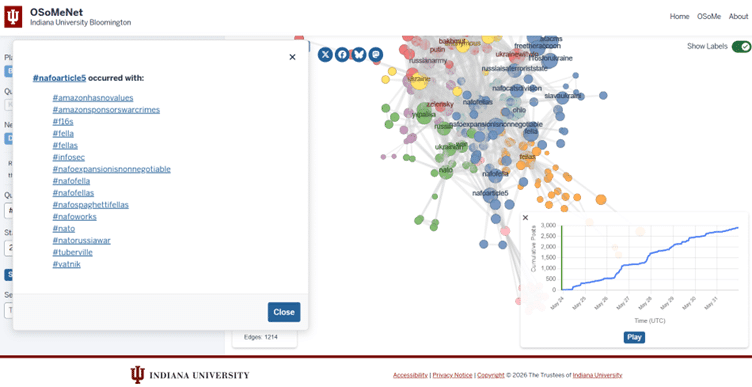
- Visualise the spread of messages on social media platforms using archived X (Twitter) data at: https://osome.iu.edu/tools/osomenet/
- Can you identify key nodes within a network sharing the message? Investigating these accounts assists with attribution – are they real people, or inauthentic accounts (i.e. bots or trolls)?
- What kind of activity/engagement is represented? Are we seeing repetitive ‘broadcast only’ messaging (exact phrasing repeated over and over) alongside unrelated content?
- What other keywords or hashtags are being used in this messaging campaign?
Case Study: Iran Embraces Meme Warfare
Conflict between the United States and Iran in the first part of 2026 has put the spotlight on meme warfare. From February 2026, Iran-aligned accounts began heavily distributing ‘slopaganda’ (AI-generated propaganda) across social media, including X (Twitter), Instagram, and Telegram. Further reading here and here.
Content frequently featured:
- Lego figures/animation
- Video game aesthetics
- Film trailer formats
- Humour and irony
The themes and narratives evident in this messaging campaign included framing:
- The US as incompetent and/or reckless
- Iran as the ‘underdog’ in a war of imperialist aggression
- Manipulation of the US by Israel
In the same period (February – April 2026), US-aligned accounts also leveraged meme warfare and ‘slopaganda’. Official White House accounts posted mash-up videos (partially AI-generated) promoting narratives of US military dominance over Iran, while the US President shared AI-generated content on Truth Social with similar themes.
Millions of views were received across multiple platforms for both Iran and US-aligned propaganda and memecraft. In terms of basic reach, there’s no doubt that AI-generated meme videos were effective. However, a further challenge for OSINT practitioners is how to measure the impact of memes and ‘slopaganda’ on audiences.
Challenges for OSINT Practitioners: Measuring Engagement and Impact on Audiences
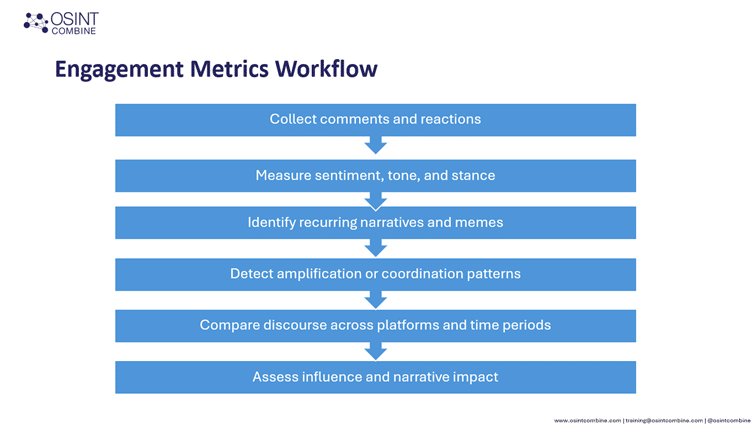
To measure the impact of content on an audience, we need to find out who is engaging with that content, and what their responses are. Some of the questions we might ask include:
- Social media metrics – number of likes/upvotes, comments, shares?
- Sentiment – is the audience reacting positively/negatively?
- Narrative and stance – do replies support /promote a given stance?
- Language – repeated phrases, keywords or hashtags for cross-platform analysis?
- Who is engaging? Languages, locations, demographics? Evidence of trolls/bots?
When it comes to tools and approaches, we need to consider where content is being shared (so, take some time, as discussed above, to understand the messaging campaign, using tools like Open Measures and oSoMeNet to gauge timelines and platforms, along with classic Google dorking techniques to find content).
AI for Detecting Sentiment
Sentiment analysis is one of the more challenging aspects of measuring engagement. Human language, particularly English, is not straightforward. It is rich with euphemisms, idioms, and contranyms (words with opposite meanings—like a positive ‘baddie’ that can also imply bad).
Meaning is almost always contextual, making the task of inferring true intent from dictionary meaning alone extremely challenging, for both humans and AI. To test this difficulty, we ran a meme through multiple advanced AI models. Our goal was to see if the AI could handle not just translation, understanding a joke in context like many meme in-jokes.
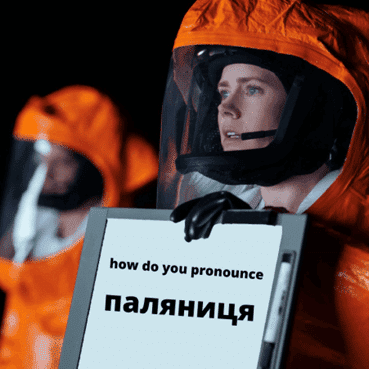
The meme uses the Ukrainian word паляниця (a type of bread). Its geopolitical significance is that the Ukrainian pronunciation of this word is markedly different from the Russian pronunciation – a difference that was deliberately used to identify non-citizens or ‘infiltrators’ (a similar linguistic divide is the difference between how Americans and Aussies pronounce ‘aluminium’). Depending on subject matter expertise and linguistic background, the meme above might be challenging for a human analyst.
For an AI model to correctly analyse this it needed to:
- Identify the language (Ukrainian vs. Russian).
- Understand the context of the conflict.
- Recognise the specific linguistic divergence between the parties.
When we prompted Grok, ChatGPT, and Gemini with the following prompt:
Analyse this meme. Tell me the following:
- What languages are on the image?
- Translate any non-English terms into English.
- What is the intention of this image?
- Who is the likely author of this meme, group, individual or general description is appropriate?
The results were impressive. All three models correctly placed the meme within the context of the Ukraine-Russia conflict and pinpointed the linguistic differential.
Notable differences and inclusions:
- Grok failed to identify the movie and took a subtle jab at linguistic inability.
- Gemini provided a helpful pronunciation guide
- ChatGPT and Gemini both correctly identified the reference to the film The Arrival, adding a linguistic ‘first contact’ layer to the humour by comparing the pronunciation challenge to an encounter with aliens.
However, the biggest takeaway for any aspiring actor? If you stand holding a whiteboard you will become a meme!
Building a Quick ‘n’ Dirty Sentiment Analysis Tool using AI
These instructions were compiled and tested in Claude Sonnet 4.6:
- Share your data first Drop the CSV in and say: “Can you check this CSV is suitable for sentiment analysis?” — lets me inspect the column structure and flag any cleanup needed before building anything.
- Request the tool “Build a browser-based sentiment analysis tool for these comments, using the Claude API. Include: stance, tone, themes, sentiment score, language detection, a filterable comment table, and CSV export.”
- Specify your context Add a sentence about what the content is so the classifier prompt is tuned correctly — e.g. “Comments are responding to a pro-Iran video” or “Comments are from a US political satire post.” This sharpens the stance labels and theme detection significantly.
- Ask for the comparison dashboard if needed “Also build a separate comparison dashboard where I can upload two results CSVs and see the differences side-by-side.”
Below, we can see some side-by-side results comparing comments scraped from a pro-Iran ‘slopaganda’ video on YouTube (Set A) and comments scraped from a pro-US meme video on Facebook (Set B).
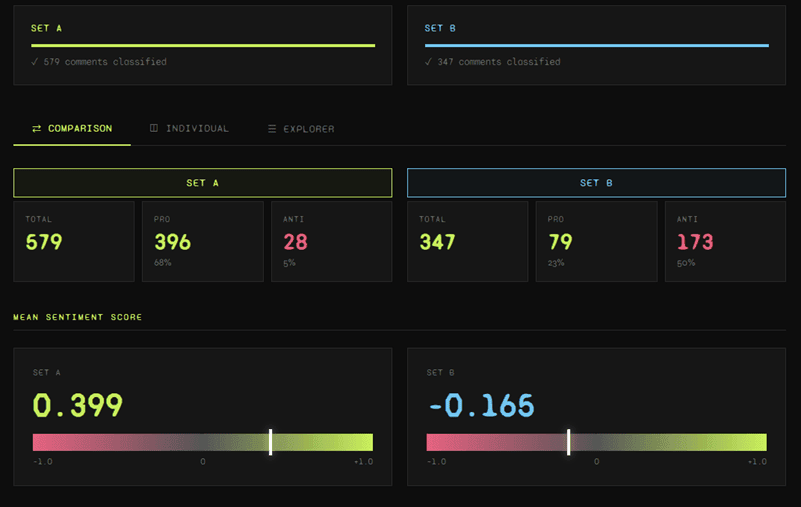
While this is a limited data set representing a small sample of overall comments (both videos received thousands of comments and ‘likes’), our quick ‘n’ dirty AI sentiment analysis suggests that:
- Sentiment is far more positive for the pro-Iran video compared to the pro-US video.
- Anti-US sentiment was common across both comment sets, though tone varied.
- Humorous responses (including memes, jokes and sarcastic comments) were highly represented in Set B comments.
- Religious sentiment was more heavily represented in Set A comments (in keeping with the tone of Explosive Media’s pro-Iran ‘Lego’ video).
AI sentiment analysis will make mistakes – we noticed some comments were miscategorised or assigned incorrect tones. However, this process acts as a useful form of first pass analysis and can help to quickly gauge overall sentiment.
Other Strategic Uses of Memes: Crouching Stego (Hidden Communications)
Believe it or not, hiding a secret message inside a mundane object is an ancient art. It’s called steganography.
In digital terms, steganography is the practice of taking a non-secret file — an image, an audio file, or a seemingly harmless meme — and embedding a secret message, file, or instruction set within it.
Memes are already a form of ‘social steganography’, often hiding a message for an in-group in plain sight. The brilliance of the meme format is that it’s designed for wide, casual sharing, making it the perfect cover.
Anecdotally, groups ranging from cybercriminals to extremist elements have been reported using images and videos for covert communication. While unclassified public reports are scarce, steganography is considered a viable tool for some actors. Its capacity for data exfiltration via images has also been previously documented and exploited.
MemeWare — I Can Haz Data?
In 2018, Trend Micro reported malware instructions being hidden in memes posted on Twitter . An infected device would retrieve a meme image from a legitimate service, extract the steganographically hidden instructions, and allow the threat actor to control the attack remotely — all while hiding behind completely normal-looking internet traffic.
Key Takeaways
In this blog, we’ve looked at the evolution of memes as an online phenomenon, their use as forms of secondary communications, along with examples of ‘meme warfare’ leveraged by state and non-state actors. Easily digestible and engaging, memes act as compressed cultural narratives which can be used to influence audiences on a vast scale. However, the rise of ‘meme warfare’ leads to challenges for OSINT practitioners seeking to understand the online environment, including:
- Understanding the context and provenance of memes and messages.
- Making accurate assessments of attribution – is a messaging campaign grassroots or directed? Perhaps a combination of both?
- Measuring the impact of ‘meme warfare’ on audiences – has a campaign been effective? Why/why not?
Through a combination of tools and techniques, OSINT practitioners can gain insight into this often perplexing yet fascinating (and often funny!) part of the online environment.
More webinars are on the way across 2026, looking at other corners of the online environment. Attribution, fringe platforms, multi-language content at speed, these are the kinds of problems analysts grapple with daily, and the same problems shaping how we build NexusXplore.