International Women’s Day 2026: Inclusive Leadership and Intelligence Capability
Amanda Schein | Mar 4, 2026 | 5 MIN READ
International Women’s Day 2026 is framed through multiple lenses. Some organisations emphasise Give to Gain. Others focus on Balance the Scales. The United Nations calls for Rights, Justice and Action. While the language differs, the direction is consistent: progress requires structural change.
In intelligence and OSINT environments, that message carries particular weight.
Leadership design is not peripheral to performance. It shapes who influences analysis, who is trusted to brief decision-makers, and whose judgement carries particular significance in moments of uncertainty. In complex, high-stakes environments, especially those increasingly supported by AI, the quality of intelligence capability depends not only on technical skill, but on how authority and opportunity are distributed.
To explore what structural change looks like in practice, we invited Jane van Tienen, Chief Intelligence Officer at OSINT Combine, and Dr Susan McGinty, Founder & CEO of The Asstembly, to share their experience and insights. Between them, they have led in demanding national intelligence environments and worked to strengthen leadership capability across STEM and security sectors.
Their perspectives converge on a clear conclusion: inclusive leadership is central to building high-quality intelligence capability.
Representation Without Redistribution
Around International Women’s Day, visible support for women is plentiful: panels, networking events, industry breakfasts and keynote speakers. These moments can be valuable. They surface role models and create space for reflection.
But visibility does not automatically redistribute authority.
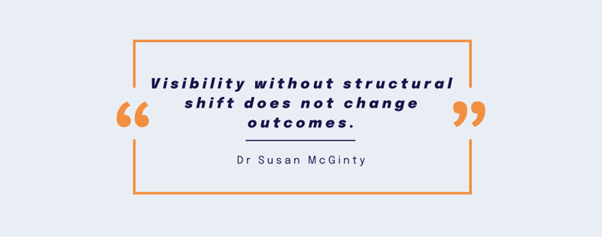
Susan describes how many organisations provide access to inspiring conversations without altering the systems that shape opportunity. Panels and events may highlight successful women, yet promotion pathways, sponsorship mechanisms and stretch-role allocation often remain unchanged. When leadership development is treated as episodic rather than structural, outcomes rarely shift.
In intelligence and OSINT teams, the distinction matters.
Stretch roles — leading a complex investigation, briefing senior stakeholders, managing an analytical team — are the environments where capability compounds. If access to those environments remains uneven, capability development remains uneven. Over time, that shapes the depth and diversity of judgement available at senior levels.
Symbolism can build morale. Structural redistribution builds intelligence capability.
Rethinking Merit in Practice
Both Jane and Susan challenge a deeply embedded norm that disproportionately shapes women’s progression in intelligence and technology sectors: how merit is defined and rewarded.
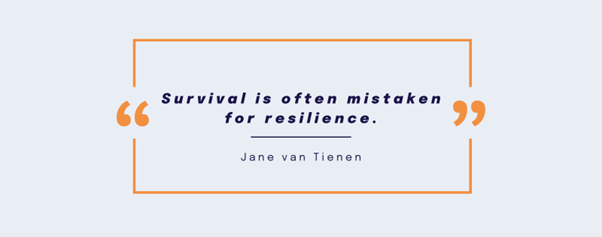
Jane argues that leaders must be willing to give up the belief that because they endured friction to earn their place, others should do the same. Yet environments that normalise unnecessary barriers do not necessarily produce stronger leaders — they may simply filter for endurance, rather than strengthening the quality of leadership judgement.
Susan similarly calls for a re-examination of how merit operates in practice. Informal networks, biased assumptions about readiness and uneven access to career-expanding opportunities can skew promotion outcomes. Merit may be declared neutral while operating through subjective filters.
In intelligence work, blind spots are treated as operational risks. Analytical tradecraft emphasises structured challenge, peer review and bias mitigation. Leadership systems, however, are rarely scrutinised with the same rigour.
If promotion pathways reward conformity over constructive dissent, or endurance over clarity of judgement, those patterns shape analytical culture. Analysts learn which behaviours are safe. Leaders learn which voices are consistently elevated. Over time, that influences how uncertainty is surfaced and how risk is interpreted.
High-quality intelligence capability depends on reducing blind spots, not institutionalising them.
Extending Authority Intentionally
Intelligence capability grows most quickly when authority is extended intentionally.
Susan describes a pivotal period early in her intelligence career when a senior executive actively sponsored her into roles she had not sought and, in some cases, did not know existed. He negotiated opportunities that broadened her exposure, placed her in environments that accelerated her growth and ultimately trusted her with a director-level role earlier than she believed she was ready for.
That intervention did more than advance a career. It accelerated capability development.
Jane reflects on a different moment, one defined by legitimacy. Acting in a senior role during a particularly high-pressure period, she received a late-night call from a peer in a partner agency who spoke to her as a genuine equal and shared his own vulnerability under strain. It was a small interaction, yet it reinforced something critical: leadership is sustained by presence and trust, not performance alone.
In intelligence and OSINT environments, confidence and legitimacy directly shape how uncertainty is communicated, how risks are escalated and how decisively leaders act under pressure.
When individuals know their authority is recognised, cognitive bandwidth shifts toward problem solving and strategic judgement. That shift strengthens the quality of discussion in briefing rooms and steadies decision-making in high-stakes environments.
Sponsorship is a deliberate investment in future intelligence capability.
Judgement in the Age of AI
As AI becomes more embedded across intelligence and OSINT workflows, technical capability expands. Automation supports scale, speed and pattern recognition. Information is processed faster and surfaced more efficiently.
What does not scale in the same way is human judgement.
Jane emphasises the importance of emotional attunement in AI-enabled environments — understanding how people place trust in systems, when friction acts as a safeguard and how confidence can quietly shift from healthy assurance to overreach. These skills are often dismissed as “soft”, yet they shape how intelligence is interpreted and acted upon.
In intelligence practice, the difference between information and insight lies in judgement. Analysts must decide which signals matter, which uncertainties require escalation and how strongly to frame assessments. Technology can assist with data, but it cannot calibrate risk on its own and leadership sets the conditions in which that judgement is exercised.
Inclusive leadership strengthens this human layer of capability. It broadens the perspectives informing analysis, encourages structured challenge and supports decision-making.
In AI-augmented intelligence environments, the strength of capability depends as much on leadership design as on technical sophistication.
Building Capability by Design
International Women’s Day creates space for reflection. Across this year’s themes, the message is consistent: visible support alone does not shape outcomes. Systems do.
In intelligence and OSINT environments, reflection must therefore translate into deliberate design.
Inclusive leadership is central to building intelligence capability that is resilient, self-aware and effective in complex environments. The question for OSINT and intelligence organisations and teams is not whether diverse leadership is valued in principle, but whether authority, opportunity and development are intentionally structured to strengthen capability.
Intelligence outcomes ultimately reflect those deliberate design choices.
About the Contributors
Jane van Tienen is Chief Intelligence Officer at OSINT Combine, bringing more than 24 years of experience in global security and intelligence. She has led teams operating in complex, high-pressure environments, with a focus on strengthening analytical capability and supporting decision-makers in security and geopolitical contexts. Jane is holding one of her favourite Australian-authored women in leadership reads by Christine Nixon and Amanda Sinclair, Women Leading (2017).

Dr Susan McGinty is Founder & CEO of The Asstembly, a leadership development organisation specialising in inclusive leadership across STEM, security and intelligence sectors. With more than 25 years of experience spanning science, defence, intelligence and national security, she works with organisations globally to strengthen leadership capability and develop resilient, high-performing teams. The Asstembly delivers nationally and internationally recognised inclusive leadership, women’s leadership and leadership excellence training, embedding leadership as a capability that amplifies technical and intelligence capability.