OSINT State of Play
Chris Poulter | Jun 23, 2026 | 9 MIN READ
It doesn’t have to be secret to be valuable: where OSINT and AI are really heading
I get asked a lot of variations on the same four questions: how is OSINT being used today, what has changed in the industry over the last five years, where does AI genuinely help versus where is it overhyped, and where is all of this going over the next few years. They’re important questions, and they deserve an objective answer rather than a sales pitch. So here are my high-level thoughts on each, and a single point I’ll keep coming back to, because it underpins everything: AI literacy.
OSINT is everywhere now and that’s the real step change
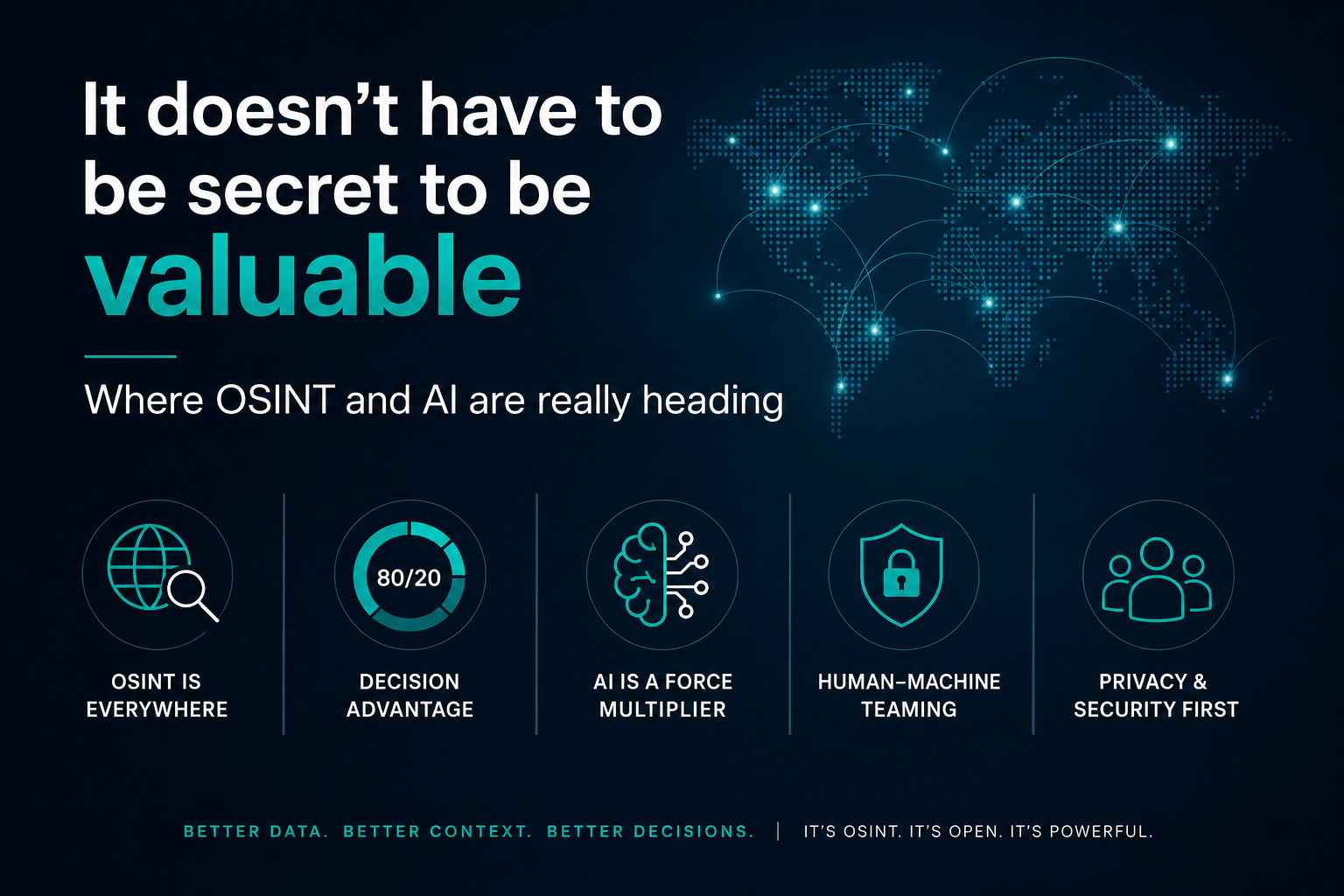
If you want the thematic version of where OSINT sits today, it comes down to two things: decision advantage and speed to insights. That’s what it unlocks. It removes many of the barriers that classified information creates while still getting you to the decision you need to make. The principle we’ve run since the start still holds: it doesn’t have to be secret to be valuable.
The biggest change over the last five years isn’t a tool or a technique. It’s status. When we started out, OSINT was treated as a nice-to-have but not always valued as much as other intelligence disciplines. It has since moved to being a critical requirement. You only need to look at the US Department of Defense strategy out to 2028 elevating OSINT to a “first resort” core intelligence discipline, and the US Intelligence Community OSINT Strategy 2024-2026 equally doing the same by defining OSINT as a co-equal, foundational discipline. Then add to that journalism, think tanks, research agencies and corporates protecting their people. OSINT is now a core discipline across all of it. That’s the macro shift, moving up the rung to first resort, and it’s an exciting place to be, with all the challenges, opportunities and risks that come attached. Privacy and security aren’t footnotes here; they’re central.
On the government side, the use cases are familiar: counter-foreign influence, counter-terrorism, counter-human-trafficking, military situational awareness, force protection, targeting and the realities of grey-zone warfare across European and South-East Asian landscapes, and the obvious law enforcement applications. The concept that resonates with most people is the 80/20 framing — if you can get 80% of what you need from OSINT, you can allocate your classified or sensitive assets against the remaining 20%. The percentages are arbitrary, but the idea is sound.
In the corporate world, where you might have limited classified holdings, OSINT plays the most important role of all. Offensive to defensive, investigations to research: digital footprint and executive exposure assessments, understanding how your people might be targeted based on what they have online, IP-theft tracking, insider threat from online and digital behaviours. People understand the value now, and there’s been a genuine evolution in the maturity curve for both corporate and government. Everyone’s on a different point of that curve and a different trajectory — but they’re on it.
Where AI genuinely helps, and where it’s overhyped
I love this topic and I speak on it all over the world. AI is a force multiplier when it’s coupled correctly, and it really is a game-changing technology — but it casts an equal shadow, and a lot of that shadow is cognitive decline. Let me break it into the pieces I think matter.
General AI tools — logging into Claude or ChatGPT and using it the way you’d use Google. The benefits are obvious. Data processing is excellent, the models keep getting better (whether you’re on Opus 4.8 or GPT-5.5), and for sensitive work, offline LLMs are very useful. Where general tooling struggles is the plain limitation of data access. The idea that someone with no OSINT experience can log into ChatGPT and replace every tool in the world is a fallacy. Ask it to write a dossier on Chris Poulter and you’ll get something — but it’ll be surface level: what’s on my LinkedIn, the website, my publications, the talks I’ve given. A good starting point, not real intelligence work. It won’t pull apart my social networks, surface the non-obvious accounts, do the attribution and cross-platform link analysis, or get to what I’m actually thinking or my intent across tangents of online conversations. The tradecraft of collection and analysis still matters — online as much as anywhere.
RAG and the data you feed it. This is where it gets interesting, and where we extend those “General AI tools”, because garbage in is still garbage out. The information you put in front of the model is the game changer. If you’ve done the tradecraft to collect vast troves of relevant data and you then focus AI on the stuff it’s great at, that’s where the benefits live — scale, efficiency, processing, pattern-finding across terabytes a human realistically can’t read. You can read it; it just takes time you don’t have if you want speed to insights. The concept I always come back to is human–machine teaming: how you find and fuse data into your AI workflows and keep control throughout the process.
Context engineering — how you set up to handle scale. If you’re working disinformation for example, you’ll have a defined workflow with 20, 30, 40 branches to triage content and networks: sourcing, motivation, actor intent, image analysis, temporal analysis, the lot. AI is genuinely useful here for triage. It doesn’t do the assessment for you — it triages the volume so you can. And the volume is the point: as of June, Cloudflare reported that more traffic across its services is now AI-bot generated than human. That needle is only going to climb exponentially. Yes, things get missed with AI triage — but far more gets missed when a human is left keyword-searching and attaching lexicons by hand. One example I present on a lot is differentiating violent ideology from violent intent at scale, because only around 1% of people move from rhetoric to action. You have to triage to focus on what matters, because we’re going to be increasingly resource-poor into the future.
So what’s actually overhyped? People point to sycophancy and hallucination as the headline risks. They’re real and worth being aware of — but every human has the same tendencies. Ask 20 analysts the same question and you might get 20 answers, with biases that were never checked because they worked in silos or organizationally those biases are entrenched. We hallucinate; we flatter. The difference is that re-engineering the behaviour of a model is easier than re-engineering the behaviour of a human — we can direct it closer. So I treat these as progressive things to manage, not showstoppers.
The risk I think is genuinely the biggest is cognitive decline — lazy OSINT that just chases outputs. The more we lean on AI to hand us a tidy summary we skim, agree with 99% of, and tweak the edges on, the more we erode our own thinking and we move further away from enhancing our understanding of the problem rather than closer to it. The comparison I always use is navigation. We used to write down turns and read the ground. Now we punch a destination into Google Maps and never blink — to the point where people stand on a street corner spinning in circles until the GPS orients them, rather than doing a simple map-to-ground. We declined cognitively in navigation and spatial awareness, and analysis faces the same risk. Use AI well, as a companion to your thinking, and you’ll be a real player. What you’ll end up with is three tiers: those who use AI and stay cognitively sharp, those who just use AI, and those who do neither. That gap is, unfortunately, likely to widen.
The other overhype is expecting complex work from a single prompt — “find this person from a photo and expose all their wrongdoings against narrative Y.” That’s not realistic today. AI is a companion, a co-pilot, a tool in the human process. Human–machine teaming is the point. It gives you scale and efficiency and gets you to decision advantage faster, but it doesn’t solve the problem for you. The good news is we all still have jobs — they’ll just run faster and look a little different.
AI literacy is the whole game — including abliterated models
This is the point I can’t stress enough. It sounds macro, but it’s actually about getting into the detail. We spend enormous effort understanding human behaviour so we can lead people better; we need to do exactly the same for AI — not just because these are becoming our co-workers, but because we need to know their opportunities and their limitations. That means staying current day to day. Not a joke — day to day. What models are dropping, open-source versus frontier, the origins of those models, and the biases baked into them.
Part of that literacy is understanding abliterated models — and yes, it’s spelt with an A; it’s a play on ablation, not “obliterated.” These are open-weight models that have had their safety guard-rails stripped out entirely. It differs from “jailbreaking” which is largely context engineering used to get past the guards at the front-door so to speak, e.g. convincing the frontier models that they should let you prompt something that would otherwise normally be blocked. Abliterated models on the other hand have far more dangerous consequences, because the safety rails to stop bad prompts are surgically removed from the model itself, so a user has free reign, with no traceability, to ask it anything they want. That cuts both ways. In the wrong hands they can help construct anything from bioterrorism to narcotics to inciting and planning attacks, offline, with no touch of the internet and no trace — and OSINT will play a key role in finding the actors using them. But used well, they let you red-team more effectively, and they’re a precise instrument for a specific diagnostic problem.
Here’s another lens on why AI literacy matters and where abliterated models come into play. Some interesting research has come out on assessing how agreeable models are to Kremlin narratives. When you test a state-of-the-art model online, you can’t tell whether a bias lives inside the weights or whether the model simply decided your question wasn’t safe to answer. That distinction matters enormously. If you want to know whether a model genuinely carries, say, a Tiananmen Square bias from a Chinese-origin model, you need an abliterated version — with the guard-rails gone — to see whether the bias is actually built into how the tokens and parameters behave. Without it, you may just be getting stopped at the door: the bouncer at the pub telling you that you can’t come in because you asked a bad question. You learn nothing about what’s actually inside. That’s why literacy matters, and it’s why, by the time you find out about something like this, it’s usually too late. If you’re using models for OSINT work, or assessing model bias, you need to know the difference between a refusal and a belief. So to anyone learning the tradecraft: keep learning the OSINT craft, absolutely — and dial your AI literacy up. That’s what will decide how well you use AI in future.
The next three to five years
It will continue to grow and expand. We’ve already shifted OSINT to a core intelligence- discipline, and I think that only deepens. AI will play an important role in how we redefine what organizations actually look like — even down to the intelligence cycle itself. You’ll stay human-heavy in some areas — planning, direction, analysis, niche collection where data access is hard — and go AI-heavy in others. Sometimes the same area, different phase: AI-heavy for surface-level collection, AI-led for processing and exploitation, AI as a companion for hypothesis testing in analysis, and certainly for dissemination. Organizations may end up changing their DNA around how they use AI.
My final point: data becomes the differentiator. You can build tools easily now — that’s great — but they’re only as good as the data behind them. A world-monitoring dashboard looks impressive and it’ll happily replace your daily news feed and global situational awareness, but it’s fairly surface level and is a lot of noise in places you don’t need. Acute, detailed intelligence requirements need targeted focus, and that still demands all the OSINT tradecraft we have. That’s paramount.
Continue the conversation at the 2026 OSINT Symposium Series
These issues will be explored further at the Australian OSINT Symposium and the US OSINT Symposium under the theme Decision Advantage with OSINT. Join Chris Poulter’s session, When the Model Won’t Say No — Abliterated AI, Threat and Tradecraft, for a practical look at how unrestricted AI models are changing the threat landscape, how to investigate their use with OSINT, and what leaders need to understand now. To find out more about OSINT Combine’s 2026 Symposium Series and to secure your ticket, visit the website – osintsymposium.com.